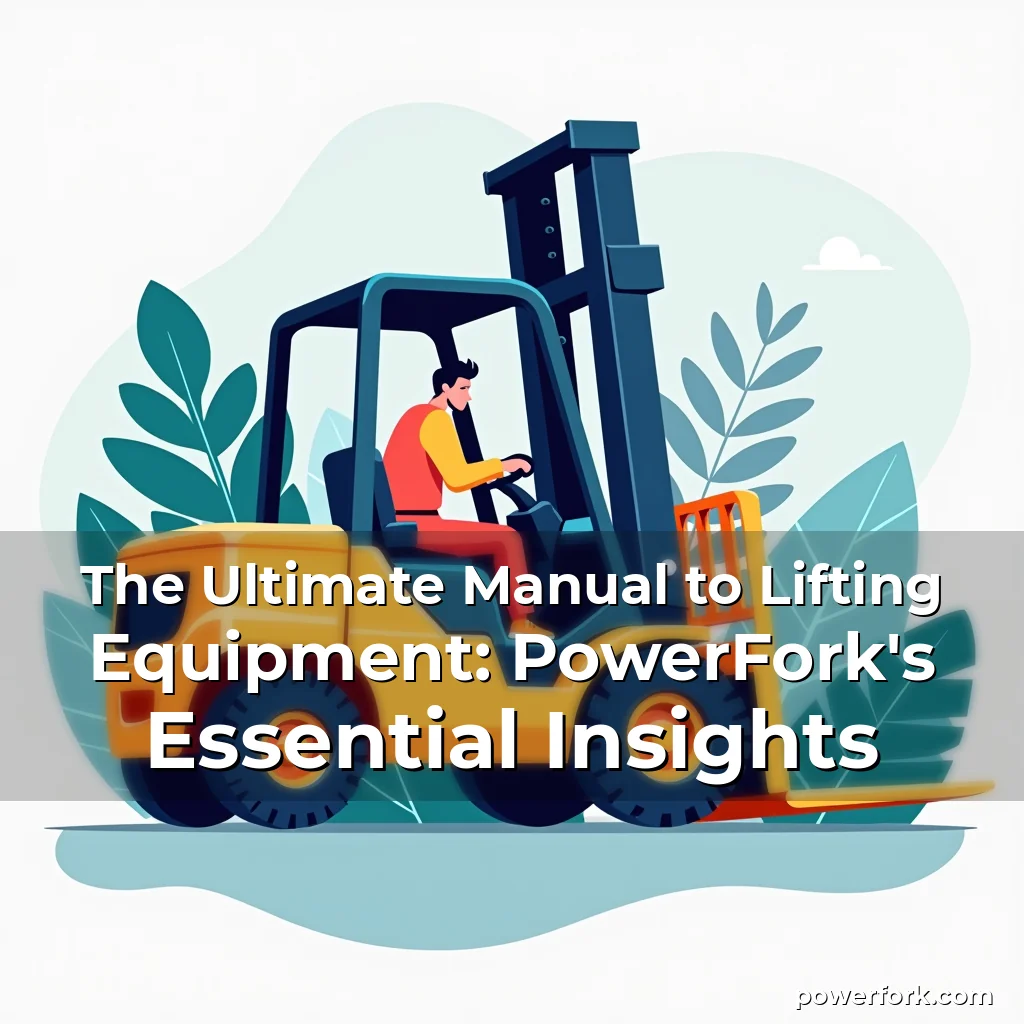
The Ultimate Manual to Lifting Equipment: PowerFork’s Essential Insights
Lifting equipment is the backbone of modern industrial operations, enabling efficient material handling across warehouses, construction sites, and manufacturing plants. For members of the PowerFork community and anyone invested in heavy-duty logistics, understanding the nuances of these tools can mean the difference between operational success and costly downtime.
Whether you’re an experienced professional or new to the field, mastering the world of lifting equipment offers invaluable benefits that extend beyond mere functionality. It encompasses safety protocols, mechanical intricacies, and strategic applications tailored to diverse environments.
Understanding the Core Components of Lifting Equipment
Lifting equipment operates through a combination of mechanical systems designed to handle vertical movement and load distribution. The primary components include hydraulic mechanisms, structural frames, control systems, and attachment points.
Hydraulic systems are particularly crucial as they provide smooth motion and precise force application. These systems typically consist of pumps, valves, cylinders, and fluid reservoirs working together to manage lift height and stability.
Structural frames serve as the foundation of any lifting device. They must be robust enough to support varying weights while maintaining flexibility during operation. Common materials used range from high-strength steel alloys to reinforced aluminum composites.
Control systems integrate both manual and automated functions. Modern devices often feature digital interfaces allowing operators to adjust parameters such as speed, weight capacity limits, and emergency stop features seamlessly.
Categorizing Types of Lifting Equipment Based on Application Needs
Different industries require specialized types of lifting equipment suited to their unique demands. This categorization ensures optimal performance and safety standards are met under various conditions.
Forklifts remain among the most common forms due to their versatility in warehouse settings. However, other variants like overhead cranes, jib cranes, stackers, and mobile elevating work platforms cater specifically to different scenarios.
- Overhead Cranes: Ideal for large-scale manufacturing where space efficiency is critical. These systems move along ceiling-mounted tracks providing extensive reach without occupying floor space.
- Jib Cranes: Perfectly suited for assembly lines requiring frequent lifting tasks within limited areas. Their rotating arms allow multi-directional movements essential for precision placements.
- Stackers: Designed primarily for narrow aisles in storage facilities, these units maximize vertical utilization by stacking pallets efficiently against walls or in compact zones.
- Mobile Elevating Work Platforms: Used extensively in construction projects; they enable workers to access elevated surfaces safely while offering mobility across job sites.
Each category comes equipped with distinct capabilities making them suitable choices based on location constraints, workload intensity, and required maneuverability factors.
Safety Standards Governing Lifting Operations
Ensuring safe usage practices around lifting equipment involves adherence to strict regulatory frameworks established globally. Organizations like OSHA enforce guidelines aimed at minimizing occupational hazards associated with improper operation techniques.
Adequate training programs form the cornerstone of accident prevention strategies. Operators must undergo regular certification courses covering topics ranging from equipment inspection procedures to emergency response protocols.
Maintenance schedules play equally vital roles in upholding reliability standards. Routine checks focusing on wear-and-tear indicators help identify potential failures before they escalate into serious incidents.
Personal protective gear remains non-negotiable regardless of experience level. Items such as hard hats, gloves, and high-visibility vests protect individuals against unforeseen accidents during routine operations.
Evolving Technologies Enhancing Lifting Capabilities
The integration of advanced technologies has significantly transformed traditional methods employed in lifting operations. Innovations now encompass automation, artificial intelligence, IoT connectivity, and enhanced sensor arrays capable of detecting anomalies in real-time.
Automated guided vehicles represent one notable advancement improving productivity metrics substantially. By eliminating human error related fatigue levels or misjudged distances, AGVs contribute towards achieving higher accuracy rates in repetitive tasks.
IoT-enabled sensors monitor key aspects including battery life status, component temperatures, vibration patterns, etc., transmitting data wirelessly back to centralized monitoring stations for analysis purposes.
Artificial Intelligence algorithms analyze historical maintenance records alongside current sensor inputs predicting possible breakdowns ahead of time thus facilitating preemptive repairs instead of reactive fixes after damage occurs.
Environmental Impact Considerations in Lifting Equipment Usage
As sustainability becomes increasingly prioritized worldwide, evaluating environmental impacts linked with lifting equipment operations assumes greater importance than ever before. Manufacturers are now developing eco-friendly alternatives addressing concerns regarding emissions output and energy consumption ratios.
Electric-powered models offer considerable advantages over conventional diesel engines when considering long-term cost savings coupled with reduced carbon footprints. Companies transitioning away from fossil fuels report measurable improvements in air quality indices surrounding their premises.
Battery technology advancements have further bolstered viability prospects for green solutions. Lithium-ion batteries exhibit longer lifespans compared to older lead-acid counterparts reducing overall waste generation volumes drastically.
Recycling initiatives targeting obsolete machinery parts ensure responsible disposal pathways exist preventing hazardous substances from entering ecosystems uncontrollably.
Optimizing Efficiency Through Proper Maintenance Practices
Maintaining peak performance levels requires implementing structured upkeep routines customized according to each piece of equipment’s specifications. Regular inspections combined with scheduled servicing intervals prevent unexpected malfunctions disrupting workflow continuity.
Following manufacturer-recommended service timelines guarantees compliance with warranty terms ensuring financial protection against premature replacements caused by negligence issues stemming from inadequate care measures taken earlier stages.
Lubrication plays a pivotal role in preserving internal moving parts longevity. Using correct viscosities specified per component type minimizes friction-induced damages prolonging useful lifespan considerably.
Tightening bolts periodically prevents loosening phenomena which could compromise structural integrity leading potentially catastrophic outcomes especially when dealing with heavier payloads consistently handled daily basis.
Selecting Appropriate Lifting Solutions According to Operational Requirements
Choosing the right kind of lifting solution depends heavily upon analyzing specific business needs thoroughly beforehand. Factors influencing decisions span across spatial limitations available, expected payload capacities required frequently, frequency rate at which lifts occur regularly, and budgetary allocations permitted initially.
Conducting thorough assessments involving site surveys enables accurate determination of ideal configurations fitting particular situations best. Consulting experts familiarize users adequately prepare them navigate complexities inherent within selection processes effectively.
Cost-benefit analyses aid decision makers weigh pros cons associated respective options carefully weighing initial outlay versus projected returns generated subsequently periods following implementation phases completed successfully.
Considering future scalability possibilities helps avoid unnecessary expenses resulting from upgrading outdated systems sooner rather later once expansion plans materialize unexpectedly demanding additional resources hastily acquired without prior preparation steps undertaken timely manner.
Conclusion
In conclusion, comprehending every aspect concerning lifting equipment empowers professionals operating within relevant sectors achieve superior results consistently meeting evolving industry benchmarks set forth continuously advancing technological landscapes.
To stay competitive amidst rapid changes occurring constantly affecting global markets today, embracing innovative approaches aligned closely with emerging trends proves instrumental securing lasting success stories worth emulating widely throughout communities engaged actively participating ongoing developments shaping tomorrow’s realities collectively.
“`
The Ultimate Manual to Lifting Equipment: PowerFork’s Essential Insights
Lifting equipment is the backbone of modern industrial operations, enabling efficient material handling across warehouses, construction sites, and manufacturing plants. For members of the PowerFork community and anyone invested in heavy-duty logistics, understanding the nuances of these tools can mean the difference between operational success and costly downtime.
Whether you’re an experienced professional or new to the field, mastering the world of lifting equipment offers invaluable benefits that extend beyond mere functionality. It encompasses safety protocols, mechanical intricacies, and strategic applications tailored to diverse environments.
Understanding the Core Components of Lifting Equipment
Lifting equipment operates through a combination of mechanical systems designed to handle vertical movement and load distribution. The primary components include hydraulic mechanisms, structural frames, control systems, and attachment points.
Hydraulic systems are particularly crucial as they provide smooth motion and precise force application. These systems typically consist of pumps, valves, cylinders, and fluid reservoirs working together to manage lift height and stability.
Structural frames serve as the foundation of any lifting device. They must be robust enough to support varying weights while maintaining flexibility during operation. Common materials used range from high-strength steel alloys to reinforced aluminum composites.
Control systems integrate both manual and automated functions. Modern devices often feature digital interfaces allowing operators to adjust parameters such as speed, weight capacity limits, and emergency stop features seamlessly.
Categorizing Types of Lifting Equipment Based on Application Needs
Different industries require specialized types of lifting equipment suited to their unique demands. This categorization ensures optimal performance and safety standards are met under various conditions.
Forklifts remain among the most common forms due to their versatility in warehouse settings. However, other variants like overhead cranes, jib cranes, stackers, and mobile elevating work platforms cater specifically to different scenarios.
- Overhead Cranes: Ideal for large-scale manufacturing where space efficiency is critical. These systems move along ceiling-mounted tracks providing extensive reach without occupying floor space.
- Jib Cranes: Perfectly suited for assembly lines requiring frequent lifting tasks within limited areas. Their rotating arms allow multi-directional movements essential for precision placements.
- Stackers: Designed primarily for narrow aisles in storage facilities, these units maximize vertical utilization by stacking pallets efficiently against walls or in compact zones.
- Mobile Elevating Work Platforms: Used extensively in construction projects; they enable workers to access elevated surfaces safely while offering mobility across job sites.
Each category comes equipped with distinct capabilities making them suitable choices based on location constraints, workload intensity, and required maneuverability factors.
Safety Standards Governing Lifting Operations
Ensuring safe usage practices around lifting equipment involves adherence to strict regulatory frameworks established globally. Organizations like OSHA enforce guidelines aimed at minimizing occupational hazards associated with improper operation techniques.
Adequate training programs form the cornerstone of accident prevention strategies. Operators must undergo regular certification courses covering topics ranging from equipment inspection procedures to emergency response protocols.
Maintenance schedules play equally vital roles in upholding reliability standards. Routine checks focusing on wear-and-tear indicators help identify potential failures before they escalate into serious incidents.
Personal protective gear remains non-negotiable regardless of experience level. Items such as hard hats, gloves, and high-visibility vests protect individuals against unforeseen accidents during routine operations.
Evolving Technologies Enhancing Lifting Capabilities
The integration of advanced technologies has significantly transformed traditional methods employed in lifting operations. Innovations now encompass automation, artificial intelligence, IoT connectivity, and enhanced sensor arrays capable of detecting anomalies in real-time.
Automated guided vehicles represent one notable advancement improving productivity metrics substantially. By eliminating human error related fatigue levels or misjudged distances, AGVs contribute towards achieving higher accuracy rates in repetitive tasks.
IoT-enabled sensors monitor key aspects including battery life status, component temperatures, vibration patterns, etc., transmitting data wirelessly back to centralized monitoring stations for analysis purposes.
Artificial Intelligence algorithms analyze historical maintenance records alongside current sensor inputs predicting possible breakdowns ahead of time thus facilitating preemptive repairs instead of reactive fixes after damage occurs.
Environmental Impact Considerations in Lifting Equipment Usage
As sustainability becomes increasingly prioritized worldwide, evaluating environmental impacts linked with lifting equipment operations assumes greater importance than ever before. Manufacturers are now developing eco-friendly alternatives addressing concerns regarding emissions output and energy consumption ratios.
Electric-powered models offer considerable advantages over conventional diesel engines when considering long-term cost savings coupled with reduced carbon footprints. Companies transitioning away from fossil fuels report measurable improvements in air quality indices surrounding their premises.
Battery technology advancements have further bolstered viability prospects for green solutions. Lithium-ion batteries exhibit longer lifespans compared to older lead-acid counterparts reducing overall waste generation volumes drastically.
Recycling initiatives targeting obsolete machinery parts ensure responsible disposal pathways exist preventing hazardous substances from entering ecosystems uncontrollably.
Optimizing Efficiency Through Proper Maintenance Practices
Maintaining peak performance levels requires implementing structured upkeep routines customized according to each piece of equipment’s specifications. Regular inspections combined with scheduled servicing intervals prevent unexpected malfunctions disrupting workflow continuity.
Following manufacturer-recommended service timelines guarantees compliance with warranty terms ensuring financial protection against premature replacements caused by negligence issues stemming from inadequate care measures taken earlier stages.
Lubrication plays a pivotal role in preserving internal moving parts longevity. Using correct viscosities specified per component type minimizes friction-induced damages prolonging useful lifespan considerably.
Tightening bolts periodically prevents loosening phenomena which could compromise structural integrity leading potentially catastrophic outcomes especially when dealing with heavier payloads consistently handled daily basis.
Selecting Appropriate Lifting Solutions According to Operational Requirements
Choosing the right kind of lifting solution depends heavily upon analyzing specific business needs thoroughly beforehand. Factors influencing decisions span across spatial limitations available, expected payload capacities required frequently, frequency rate at which lifts occur regularly, and budgetary allocations permitted initially.
Conducting thorough assessments involving site surveys enables accurate determination of ideal configurations fitting particular situations best. Consulting experts familiarize users adequately prepare them navigate complexities inherent within selection processes effectively.
Cost-benefit analyses aid decision makers weigh pros cons associated respective options carefully weighing initial outlay versus projected returns generated subsequently periods following implementation phases completed successfully.
Considering future scalability possibilities helps avoid unnecessary expenses resulting from upgrading outdated systems sooner rather later once expansion plans materialize unexpectedly demanding additional resources hastily acquired without prior preparation steps undertaken timely manner.
Conclusion
In conclusion, comprehending every aspect concerning lifting equipment empowers professionals operating within relevant sectors achieve superior results consistently meeting evolving industry benchmarks set forth continuously advancing technological landscapes.
To stay competitive amidst rapid changes occurring constantly affecting global markets today, embracing innovative approaches aligned closely with emerging trends proves instrumental securing lasting success stories worth emulating widely throughout communities engaged actively participating ongoing developments shaping tomorrow’s realities collectively.
“`